Why Forgetting Is Not a Bug
The brain is not a hard drive. It runs two interleaved systems: a memory system that captures and stores information, and an active forgetting system that erodes what is not reinforced. The second is the under-discussed half, and it is what this article is about.
The memory system is the one most people learn about. It moves through four stages. Gathering brings information in through the senses. Encoding translates sensory data into a storable form. Storage holds new memories in the hippocampus and gradually transfers them into distributed networks across the neocortex. Retrieval reactivates the specific neural networks that hold a memory, which is why recalling a memory tends to strengthen and sometimes subtly rewrite it rather than simply replay it. A century of cognitive neuroscience has mapped this pipeline in considerable detail.
The forgetting system is different machinery, and it works alongside memory rather than against it. Three mechanisms have been characterized so far. Active forgetting erodes molecular and cellular traces of stored memories, which supports generalization and abstraction. Synaptic pruning weakens connections that are not regularly accessed through long-term depression, until the connection disappears entirely. Working memory decay lets unreinforced short-term information fade within seconds or minutes. Together, these mechanisms keep cognition running efficiently by making room for new learning and preventing the system from drowning in unfiltered detail.
Three independent lines of neuroscience research, published across roughly six years and three different experimental traditions, converge on a claim that sounds counterintuitive until you sit with it: forgetting is not a failure of memory; it is what makes memory useful. This article is about that body of research, the AI architectures that are now converging on the same principle from a very different direction, and what the convergence changes for operators working at four different scales.
Three Research Lines on Active Forgetting
The first line comes from Paul Frankland and Blake Richards at the University of Toronto. In a 2017 review in Neuron, they argued that the primary objective of memory is not to record every detail, but to optimize intelligent decision-making by filtering useless data. They identified two biological mechanisms that actively prune memories: synaptic weakening, in which connections between neurons gradually degrade and reduce access to older memories; and neurogenesis, in which new neurons generated from stem cells integrate into the hippocampus, remodel existing circuits, and overwrite older traces. This is part of why children, who produce new neurons at a higher rate than adults, also forget more.
The benefit of this pruning is twofold. Flexibility: discarding outdated information prevents conflicting memories from hindering current decisions. Generalization: retaining essential patterns rather than specific details lets knowledge transfer to new situations. The parallel to machine learning is direct. Models that memorize their training data, what practitioners call overfitting, perform worse on new inputs than models that learn to generalize by discarding noise. Regularization is a forgetting policy with a different name.
The second line comes from Tomas Ryan and Livia Autore at Trinity College Dublin in 2023, and it tested what actually happens to memories the brain labels as forgotten. Their experiments centered on retroactive interference, the phenomenon where new experiences make recently formed memories inaccessible. The surprising result: memories tagged as forgotten were not erased. Using optogenetics to reactivate specific neurons, the researchers successfully retrieved the supposedly lost memories. More importantly, naturally occurring new related experiences could reactivate the same traces and update them with current information.
The implication reframes forgetting as a form of learning. The brain does not lose information carelessly. It strategically reduces access to information that conflicts with current needs, while keeping the underlying traces available for future reactivation. The label forgotten turns out to be a routing decision, not a deletion event.
The third line, a 2017 perspective from Ronald Davis at Scripps Research and Yi Zhong at Tsinghua, goes deeper into the molecular machinery. Davis and Zhong argued that forgetting is an active biological process with its own dedicated pathways, comparable to how cells have separate systems for building and for demolishing structures. The best-characterized mechanism involves dopamine neurons releasing signals that activate the Rac1/cofilin pathway, which remodels the structural connections between neurons. This weakens synapses and degrades traces by design.
The concept Davis and Zhong introduced, intrinsic forgetting, describes chronic signaling systems that slowly degrade molecular memory traces as a default state. Memories survive only when actively consolidated, not when passively stored. The baseline operation of the brain is to forget; remembering is the exception that requires effort. The asymmetry matters: maintenance, not deletion, is what costs energy.
Three independent labs, three different experimental traditions, one converging claim: the brain has dedicated biological machinery for selective forgetting, and that machinery is load-bearing for everything downstream.
Where AI Is Converging on the Same Principle
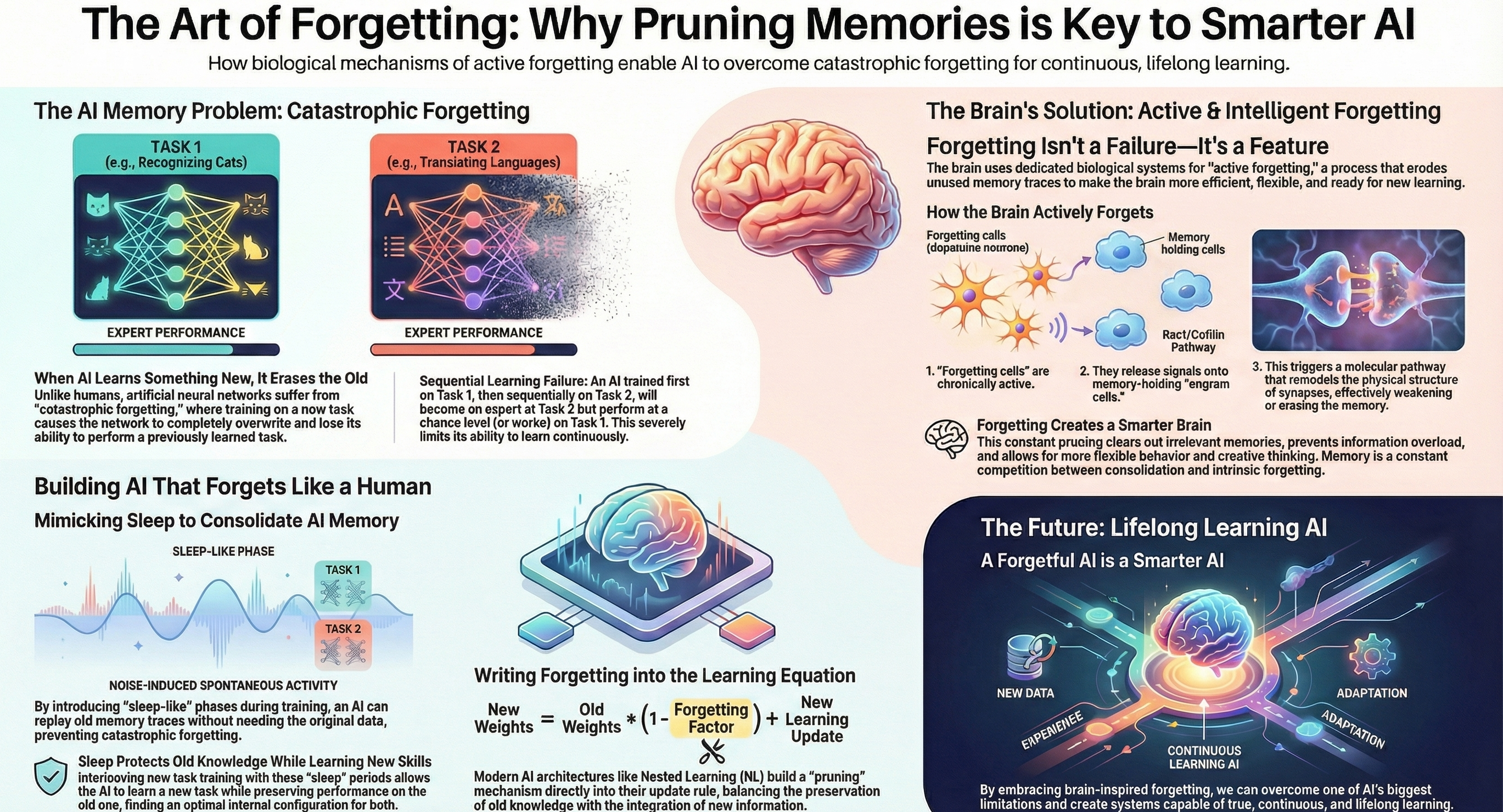
The parallel between human and artificial memory systems looks like more than analogy. It looks like convergent solutions to the same fundamental problem: how does a finite system operate inside an infinite stream of information?
| Human Mechanism | AI Equivalent | What It Solves |
|---|---|---|
| Synaptic pruning | Weight decay, parameter pruning | Removing connections that no longer serve current objectives |
| Sleep consolidation | Memory consolidation phases | Reorganizing knowledge to support multiple tasks simultaneously |
| Selective recall (engram accessibility) | Attention mechanisms, context windowing | Prioritizing relevant information at retrieval time |
| Neurogenesis (new neurons overwriting old circuits) | Architecture retraining, fine-tuning | Incorporating new capabilities without preserving every past state |
| Generalization through forgetting | Regularization, dropout | Preventing overfitting; improving transfer to new inputs |
The most concrete recent example of this convergence is Google's Titans architecture, published in early 2025. Titans introduces an adaptive forgetting mechanism that discards outdated information through weight decay during inference, and uses surprise metrics to prioritize novel inputs over routine ones. The system does not try to remember everything; it learns what to keep. The architectural insight is that selective deletion at the right cadence is a performance feature, not a limitation.
The same logic appears in production RAG systems, though less explicitly. A retrieval pipeline that indexes every document in a knowledge base without pruning returns more noise than signal as the corpus grows. The systems that retain relevance over time are the ones with active demotion: stale documents get downweighted, deprecated versions get removed from the retrieval pool, recency biases get tuned. None of this is glamorous engineering. It is forgetting policy.
What both biology and AI have figured out, independently, is that better performance comes from improving selectivity, not from adding capacity. The frontier is not memory; it is the discipline of selection. The substrate is different. The shape of the solution is the same.
What Changes at Each Tier
The forgetting principle applies differently at each scale of effectiveness, and the operator move is different at each one. Most teams I have worked with try to solve a forgetting problem at the wrong tier, and the result is a fix that does not hold.
Individual
For an individual working with AI tools, the unit of work is the context window. A prompt stuffed with irrelevant background degrades model performance in the same way a person trying to recall a fact while mentally replaying an unrelated argument performs worse on the recall task. The model has finite attention. So does the human.
The operator move is curation. Treat the context window as a resource to optimize, not a container to fill. Prune irrelevant background before prompting. Reuse the same scaffolding across similar tasks and refine it deliberately rather than rebuilding it from scratch. The discipline that pays off most consistently, in my experience, is rereading your own prompts at the end of a week and removing the lines that did not move the output. Most prompt libraries grow without curation for the same reason most desks do: deletion takes a deliberate decision that nobody schedules.
Team
Shared knowledge systems accumulate without curation almost by default. Wikis, documentation, Slack history, and shared drives all behave like organizational attics. Everything is technically stored, almost nothing is findable when it matters. The team-level forgetting failure is that the team has a retention policy and no forgetting policy.
The operator move is to invert that balance. Sunset deprecated processes on a fixed cadence. Archive outdated documentation rather than letting it shadow the current version in search results. Mark Slack threads with explicit half-lives where the convention allows it. The Tower of Babel article elsewhere in this journal made an adjacent argument about how shared definitions are a precondition for cross-functional reasoning; the equivalent at the team level is that shared current context is a precondition for cross-functional speed. Keeping it current means knowing what to discard.
Organization
Enterprise RAG systems face the same trade-off at scale. A retrieval pipeline that indexes everything tends to return more noise than signal over time. The failure mode is invisible until measured: retrieval volume keeps growing while retrieval relevance erodes, and the system looks healthy until users stop trusting it.
The operator move is active pruning of the retrieval corpus, weighting recent and high-signal documents more heavily, detecting and demoting stale content, and measuring retrieval relevance as a first-class metric rather than retrieval volume. The organizations I have watched get this right have a named owner for corpus health, not a committee. The pattern echoes the argument I made in The Trust Gap: shared accountability collapses into nobody's accountability, and the corpus rots the same way an unowned recommendation rots.
Ecosystem
At the ecosystem level, the forgetting principle becomes a design philosophy. The systems that thrive over time, biological or artificial, are not the ones with the most data. They are the ones that have learned what to ignore.
Ecosystems of AI tools, agents, and knowledge systems that hoard everything eventually struggle under their own weight. The ones that scale are designed around selective retention, with the boundary between keep and discard treated as a continuous decision rather than a one-time policy. The lesson is the same lesson the brain has been demonstrating for several hundred million years: the selective system outperforms the comprehensive one, every time the environment changes faster than the storage does.
What I Do Not Yet Know
I have watched the curation-at-the-individual-tier discipline transfer cleanly between people who decide to internalize it. I have also watched it fail to scale to teams in a specific way: individual operators internalize the discipline for their own prompts and then refuse to apply it to shared documentation, because the social cost of deleting someone else's work is much higher than the social cost of deleting your own draft. The friction is not technical. It is interpersonal.
My current hypothesis is that team-level and organization-level forgetting requires a named owner for the discard decision, not just for the retention decision, and that most organizations have only the latter. The named-owner pattern that closes the trust gap appears to apply directly to corpus health: someone has to be accountable for what gets removed, not just for what gets added. I am running a small version of this experiment now in a corpus-management context, and the early signal is that the discard owner is the harder role to staff than the retention owner.
If you have run a similar pattern at team or organization scale and have a counter-example, either a version that scaled cleanly without a named discard owner or a named-owner version that produced more theater than discipline, I would genuinely like to compare notes. The mechanism by which one shape converts and another does not is the kind of thing where operator notes from a half-dozen people are worth more than another literature review.